Saturday, May 4, 2013
Linda Root, Indie writer: The scene from Last Knight and the Queen of Scots ...
Linda Root, Indie writer: The scene from Last Knight and the Queen of Scots ...: The scene from Last Knight and the Queen of Scots that I find most characteristic of the novel is one that takes place the day after Marie S...

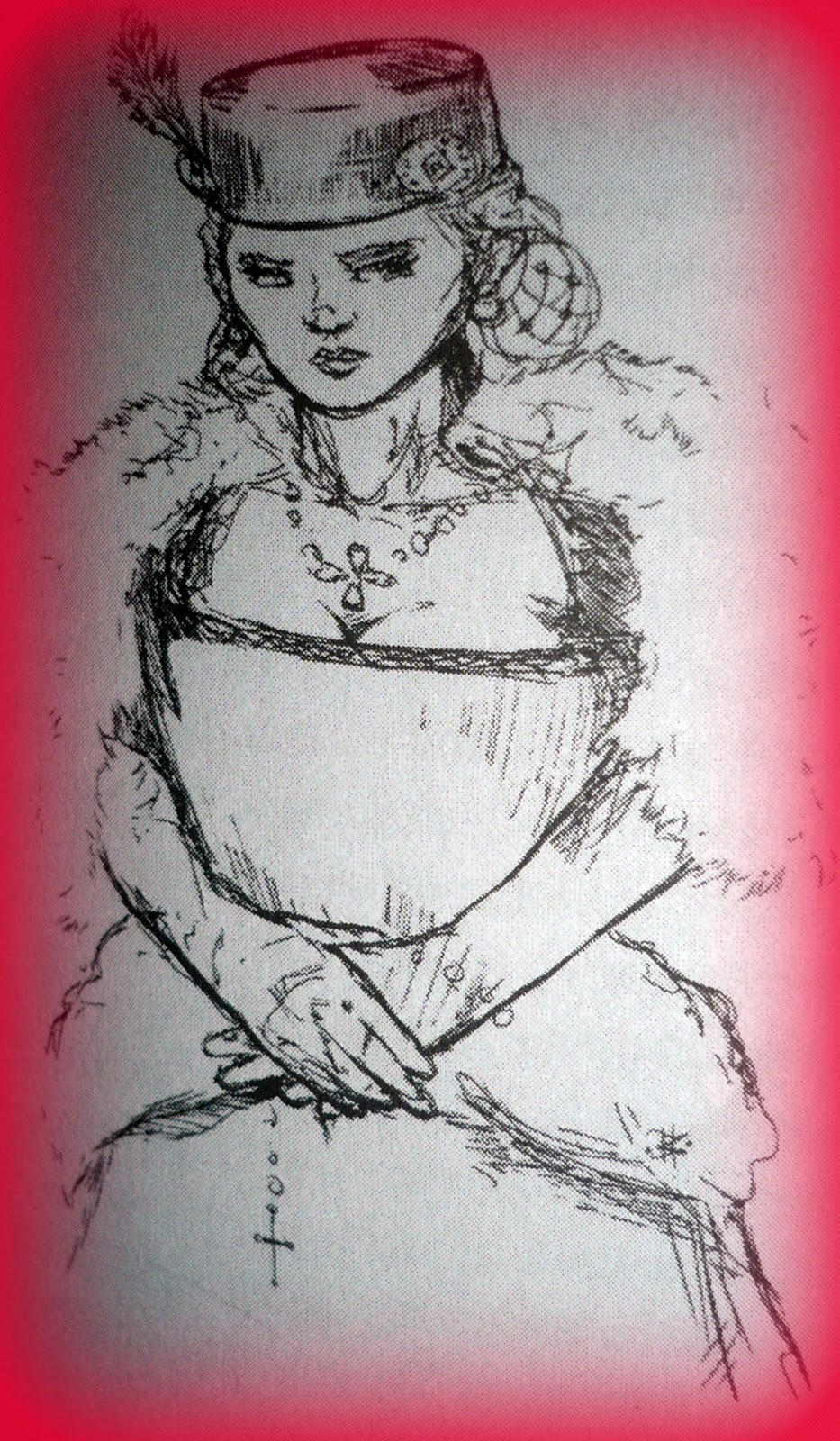
The scene from Last Knight and the Queen of Scots that I find most characteristic of the novel is one that takes place the day after Marie Stuart surrendered to Kirkcaldy of Grange at Carberry Hill. At Carberry, Marie agreed to disburse her troops and go with the lairds to Edinburgh if they would allow her husband James Hepburn, Earl of Bothwell and Duke of Orkney leave the battlefield unmolested. She was told that she would be taken to Holyrood where she would remain Queen of Scots, but with some restrictions on her powers until she freed herself of Bothwell's thrall. They parted with a passionate kiss and Bothwell rode away. I did a drawing of the scene as I perceived it, with Bothwell showing faintly in the background. At any rate, by the following day, both Marie and Kirkcaldy realize that the lairds of the congregation have no intention of adhering to the negotiated terms. While no one has told her what the lairds have planned for her, her base treatment at the hands of an Edinburgh mob is enough to warn her that the lairds have changed the game. To silence Kirkcaldy's protests that his honor had been tarnished, they show him a letter allegedly written to Bothwell by Marie during the night. That sets the stage for the following exchange between them in a fictional dramatization of an actual event.

THE LAST KNNIGHT and the Queen of Scots- The Adventures of Sir William Kirkcaldy of Grange, by Linda Root, pps 578-584:
It had been wrong to come here.
The room smelled of grief and fear. The horror of it set him frozen in the doorway. The Queen was cowering on the barren floor. Her borrowed, rumpled kirtle was wrapped around her like a shroud. She did not raise her eyes at first, but when she did, he saw a flash or raw hatred that faded to disdain. She had not capitulated. She was still the Queen of Scots.
She drew her knees up and locked her long, bare arms across them, resting her chin upon her hands. They no longer trembled as they had the night before. She stabbed him with the same gaze he remembered from her childhood when something had been denied her.
“You promised, Kirkcaldy. You gave me your word.” She had echoed the same reprimand that he had been muttering to himself throughout the long night. But Maitland had been correct. His guilt had diminished when shown the letter.
“I saw the note you penned to your paramour, Madame. It absolved me of my vow.”
Now she saw the purpose behind the stylus and the writing paper, and the reason why a servant had been commandeered to deliver the table when even crippled Maitland could have managed it with ease. He was to be the witness!
“Haw!” she scoffed. She shook her head back and forth until her wild hair fell forward. She brushed the stray locks out of her eyes with her right hand, and again wrapped her arms around her knees, locking herself up again. She raised her head and sneered.
“That has always been your trouble, Grange. For all of your girth and height, you are sometimes such a small man, so easily manipulated by those around you.”
The words stung to the quick. He struck back childishly.
“And Bothwell is someone bigger? It was he, not me, Madame, who in three short months manipulated you into tossing a crown down Carberry Hill to Morton’s feet. It was he who in a few minutes of gentle talk from you was happy enough to get on his horse and ride away, abandoning you to whatever fate befalls you. Which of you rides free to Dunbar now?”
“He was not happy to leave me there, Sir,” she corrected.
She adjusted the torn garments to cover her breasts, and prepared to stand. Kirkcaldy had been her liege for far too long to watch her struggle. He rushed to help her, but she curled her hand into a fist and warned him to keep back. It was painful to watch her stranded on her knees. She planted a bare foot on the cold stone floor and straightened the first leg and then the other, steadying herself against the little table as she rose. When she drew herself to her full height, they met eye to eye.
“Indulge me one last time, Kirkcaldy. Last night when you left me to the mercies of the rabble outside of my window and bolted the door behind yourself, did I appear to you as someone who was capable of writing a love letter? And where exactly on my near naked body had I hidden my parchment and my writing instrument? And if not hidden, how do you suppose I acquired them? Who gave them to me and why? Are you that gullible, Sir?”
She had abandoned the use of the royal plural. There were no protocols in force.
“They gave you writing materials so that you could write to Elizabeth renouncing Hepburn and requesting safe passage home for your brother Lord James.”
“Aha! Maitland writes a clever dialogue.” She laughed, but then turned sullen.
“Madame, Maitland and your brother James only wish to free you from the devil’s thrall.”
“I have no brother called James. The one I had is dead.” She looked at him with the hardened eyes of the street whore that the mob outside had accused her of being. He wanted to take her in his arms, to give her comfort, not in a sexual way, but as a father to a child. He wanted to fall on his knees before her, and renew the vows he had taken in France. He felt a tear forming and he squinted hard to keep it prisoner. It was betraying him just as he had betrayed the queen.
Then the Queen of Scots uttered the deepest sigh he had ever heard.
“I trusted you,” she lamented. It was not a reproach, but a statement of fact.
“I would have died for you, Madame. We all would have died for you.”
She let out another sigh, this one steeped with exasperation.
“And Bothwell changed all that?”
All he was able to do was nod. She raised her hands to her elegant neck and shuddered, this time not quite so heavily.
“But you did not die for me, Sir! Poor Sweet Davie died for me, and I suppose we could give the benefit of the doubt to feckless, stupid Henry, who certainly died because me, but no one else has died for me, not even François, who merely died. Perhaps he was the lucky one.”
“Bothwell rode off and left you alone on the hill,” he retorted, as if it absolved the rest of them of myriad acts of treachery and deceit.
“Because I commanded it! Aye, Kirkcaldy, my last words to my husband were spoken as a queen, not as a wife, and may God condemn me for that.” Her voice crescendoed as she spoke. Something in her manner changed—a small adjustment to the light in her eyes.
“He did not seem to ponder it very long, Madame.”
Kirkcaldy had stated the obvious, but it still did not answer the queen’s argument.
“If Bothwell was the devil who drove me to that cursed hilltop, Sir, then why me? Why are you not out there chasing this Satan of your creation? Why am I the one locked in this hideous room, with a mob outside waiting to set faggots to the hem of my gown?”
Then she looked down and gave a wry chuckle.
“--As if I had either hem or gown.”
She walked toward the window, but stopped before she reached it.
“The English sent Saint Joan of Orleans a new frock to wear to her emolument. Perhaps Elizabeth will do the same for me.”
Kirkcaldy reached her side. He wished to place his hand on her shoulder, to placate her, but she spun to face him. Her eyes sent a warning that he dare not touch her. All he could offer was speech, and even then he would be wise to watch his words. She who had trusted him enough to place herself in his care had nothing left for him but scorn.
“There is no plan to burn you, Madame, or to otherwise harm you or your son.”
Her eyes skewered him again.
“Entertain me, then, with an answer to my question: If it is Bothwell that you find so odious, why am I here whilst he is free?”
“It is you who set him loose, Madame.”
“Ah, yes, Kirkcaldy. The subject must obey his sovereign.”
The irony was thick enough to repel a broadsword. Kirkcaldy had no further answers to the queen’s question. When she had surrendered to him at Carberry, he thought he had spoken truly-- that the lairds marched to free the queen from Bothwell’s thrall.
There had been a bond signed by more lairds than he could list. They had sworn that their sole objective was to separate the captive from her captor until her senses were restored. Freeing Bothwell had been the prize offered to get her to acquiesce. Killing him would have been a better move. Without Marie beside him, Hepburn was without the power to cause any serious damage. His inability to raise more than a token force of mercenaries and border ruffians was evidence of that. The plan to which Kirkcaldy had subscribed was to deliver the Queen into house arrest at Holyrood, surrounded by all of her elegant furnishings and treasures, with her ladies to attend her. There would be minor alterations to the composition of her household, and a prohibition against the Mass. Ladies from protestant families would replace the remnant of French women remaining in her personal service. Marie Seton and Jane Kennedy would remain. As soon as she was settled in, she would be allowed visitation with the prince and permitted to travel to Stirling for his birthday. She would retain her crown, and be titular Queen of Scots, while Maitland, Morton and her brother formed a triumvirate ruling in her name. Such a scheme had served her well enough when she first arrived in Scotland. She would divorce and remarry in the Protestant faith when the time was ripe. That had been the plan. Locking her up had not been part of it. Her humiliation had not been part of it.
Kirkcaldy was not naïve enough to believe his own lame assertion that a single love note of uncertain authenticity had changed it all. As soon as the queen convinced Bothwell to ride into the sunset, the rules apparently changed for everyone but him. He sickened with suspicion that Marie Stuart was telling him the truth--the letter was nothing more than a fraud produced to coerce his silence—one of Maitland’s tricks. Perhaps his erstwhile friends had used the queen’s trust and his own sense of honor to trap them both. He was easily manipulated by men cleverer than he—a sword to be unsheathed for others to wield as they saw fit.
“If you renounce him, Majesty, your life will return to normal. The lairds will have no other choice.” He thought he spoke honestly. Then she did laugh, aloud and robustly, a laugh of a lunatic, like Arran’s laugh. But when the queen spoke, there was no madness in her taunt.
“When exactly, Sir, has my life been normal? You were with me in France and know better than most. And as for the Earl of Bothwell, I would indeed follow him to the edge of the world in nothing but a petticoat of whatever color I choose-- white or red makes no matter--for reasons you will never understand.”
Then she stopped speaking for a moment, to catch a thought she apparently found amusing. “…if indeed I had a petticoat, instead of this borrowed rag.”
She lifted the edge of the dirty garment.
“Perhaps if I crawl to yonder window and bare my breasts to the crowd, some snot-nosed hag will loan me hers.”
Then she became wistful.
“Do you have any idea how novel it was to be treated as nothing more or less than a desirable woman? The Duke of Orkney may have made rough use of tender flesh, but at least it has been real. And to act as if he has despoiled me of my virtue is a crude joke. I had been ravished a thousand times by many men before I ever reached the Almond Bridge. The others were more subtle, but more cruel. My life as queen has been an endless series of ravishments.”
She was silent for a moment, and Kirkcaldy thought she had finished, but she had been reflecting on the story of her life.
“…I should have melted down Elizabeth’s garish font and taken my son to France.
They both realized that it had gone too far for that.
“Is there anything I can offer to relieve you of your distress, Madame?” Kirkcaldy asked and immediately wished he had not said it. The queen sucked on her lower lip and shook her head. She raised the elegant hand that clutched the rags of her undergarment, and seemed about to wave him off, but instead she dropped her arms and faced him.
“A sgian dubh would be nice, but if you cannot find a way to part with yours, you might leave your cloak behind so I can have something to cover my naked breasts.”
After he removed his cloak and placed it on the cot, Kirkcaldy bent at the waist and began to back out of her presence.
“Do not bother with such absurdities, Grange. Turn your back on me like the others have done and bolt the door behind you when you leave.”
THE LAST KNNIGHT and the Queen of Scots- The Adventures of Sir William Kirkcaldy of Grange, by Linda Root, pps 578-584:
Kirkcaldy did not want to go inside the
awful little room.
Bile rose in his throat in a manner he had not
experienced since the day he had thundered into the kitchen at Saint Germain
and knocked the spoon from Mally Fleming’s hand. Then he had saved Marie Stuart
from her enemies. Now he had become one of them.It had been wrong to come here.
The room smelled of grief and fear. The horror of it set him frozen in the doorway. The Queen was cowering on the barren floor. Her borrowed, rumpled kirtle was wrapped around her like a shroud. She did not raise her eyes at first, but when she did, he saw a flash or raw hatred that faded to disdain. She had not capitulated. She was still the Queen of Scots.
She drew her knees up and locked her long, bare arms across them, resting her chin upon her hands. They no longer trembled as they had the night before. She stabbed him with the same gaze he remembered from her childhood when something had been denied her.
“You promised, Kirkcaldy. You gave me your word.” She had echoed the same reprimand that he had been muttering to himself throughout the long night. But Maitland had been correct. His guilt had diminished when shown the letter.
“I saw the note you penned to your paramour, Madame. It absolved me of my vow.”
Now she saw the purpose behind the stylus and the writing paper, and the reason why a servant had been commandeered to deliver the table when even crippled Maitland could have managed it with ease. He was to be the witness!
“Haw!” she scoffed. She shook her head back and forth until her wild hair fell forward. She brushed the stray locks out of her eyes with her right hand, and again wrapped her arms around her knees, locking herself up again. She raised her head and sneered.
“That has always been your trouble, Grange. For all of your girth and height, you are sometimes such a small man, so easily manipulated by those around you.”
The words stung to the quick. He struck back childishly.
“And Bothwell is someone bigger? It was he, not me, Madame, who in three short months manipulated you into tossing a crown down Carberry Hill to Morton’s feet. It was he who in a few minutes of gentle talk from you was happy enough to get on his horse and ride away, abandoning you to whatever fate befalls you. Which of you rides free to Dunbar now?”
“He was not happy to leave me there, Sir,” she corrected.
She adjusted the torn garments to cover her breasts, and prepared to stand. Kirkcaldy had been her liege for far too long to watch her struggle. He rushed to help her, but she curled her hand into a fist and warned him to keep back. It was painful to watch her stranded on her knees. She planted a bare foot on the cold stone floor and straightened the first leg and then the other, steadying herself against the little table as she rose. When she drew herself to her full height, they met eye to eye.
“Indulge me one last time, Kirkcaldy. Last night when you left me to the mercies of the rabble outside of my window and bolted the door behind yourself, did I appear to you as someone who was capable of writing a love letter? And where exactly on my near naked body had I hidden my parchment and my writing instrument? And if not hidden, how do you suppose I acquired them? Who gave them to me and why? Are you that gullible, Sir?”
She had abandoned the use of the royal plural. There were no protocols in force.
“They gave you writing materials so that you could write to Elizabeth renouncing Hepburn and requesting safe passage home for your brother Lord James.”
“Aha! Maitland writes a clever dialogue.” She laughed, but then turned sullen.
“Madame, Maitland and your brother James only wish to free you from the devil’s thrall.”
“I have no brother called James. The one I had is dead.” She looked at him with the hardened eyes of the street whore that the mob outside had accused her of being. He wanted to take her in his arms, to give her comfort, not in a sexual way, but as a father to a child. He wanted to fall on his knees before her, and renew the vows he had taken in France. He felt a tear forming and he squinted hard to keep it prisoner. It was betraying him just as he had betrayed the queen.
Then the Queen of Scots uttered the deepest sigh he had ever heard.
“I trusted you,” she lamented. It was not a reproach, but a statement of fact.
“I would have died for you, Madame. We all would have died for you.”
She let out another sigh, this one steeped with exasperation.
“And Bothwell changed all that?”
All he was able to do was nod. She raised her hands to her elegant neck and shuddered, this time not quite so heavily.
“But you did not die for me, Sir! Poor Sweet Davie died for me, and I suppose we could give the benefit of the doubt to feckless, stupid Henry, who certainly died because me, but no one else has died for me, not even François, who merely died. Perhaps he was the lucky one.”
“Bothwell rode off and left you alone on the hill,” he retorted, as if it absolved the rest of them of myriad acts of treachery and deceit.
“Because I commanded it! Aye, Kirkcaldy, my last words to my husband were spoken as a queen, not as a wife, and may God condemn me for that.” Her voice crescendoed as she spoke. Something in her manner changed—a small adjustment to the light in her eyes.
“He did not seem to ponder it very long, Madame.”
Kirkcaldy had stated the obvious, but it still did not answer the queen’s argument.
“If Bothwell was the devil who drove me to that cursed hilltop, Sir, then why me? Why are you not out there chasing this Satan of your creation? Why am I the one locked in this hideous room, with a mob outside waiting to set faggots to the hem of my gown?”
Then she looked down and gave a wry chuckle.
“--As if I had either hem or gown.”
She walked toward the window, but stopped before she reached it.
“The English sent Saint Joan of Orleans a new frock to wear to her emolument. Perhaps Elizabeth will do the same for me.”
Kirkcaldy reached her side. He wished to place his hand on her shoulder, to placate her, but she spun to face him. Her eyes sent a warning that he dare not touch her. All he could offer was speech, and even then he would be wise to watch his words. She who had trusted him enough to place herself in his care had nothing left for him but scorn.
“There is no plan to burn you, Madame, or to otherwise harm you or your son.”
Her eyes skewered him again.
“Entertain me, then, with an answer to my question: If it is Bothwell that you find so odious, why am I here whilst he is free?”
“It is you who set him loose, Madame.”
“Ah, yes, Kirkcaldy. The subject must obey his sovereign.”
The irony was thick enough to repel a broadsword. Kirkcaldy had no further answers to the queen’s question. When she had surrendered to him at Carberry, he thought he had spoken truly-- that the lairds marched to free the queen from Bothwell’s thrall.
There had been a bond signed by more lairds than he could list. They had sworn that their sole objective was to separate the captive from her captor until her senses were restored. Freeing Bothwell had been the prize offered to get her to acquiesce. Killing him would have been a better move. Without Marie beside him, Hepburn was without the power to cause any serious damage. His inability to raise more than a token force of mercenaries and border ruffians was evidence of that. The plan to which Kirkcaldy had subscribed was to deliver the Queen into house arrest at Holyrood, surrounded by all of her elegant furnishings and treasures, with her ladies to attend her. There would be minor alterations to the composition of her household, and a prohibition against the Mass. Ladies from protestant families would replace the remnant of French women remaining in her personal service. Marie Seton and Jane Kennedy would remain. As soon as she was settled in, she would be allowed visitation with the prince and permitted to travel to Stirling for his birthday. She would retain her crown, and be titular Queen of Scots, while Maitland, Morton and her brother formed a triumvirate ruling in her name. Such a scheme had served her well enough when she first arrived in Scotland. She would divorce and remarry in the Protestant faith when the time was ripe. That had been the plan. Locking her up had not been part of it. Her humiliation had not been part of it.
Kirkcaldy was not naïve enough to believe his own lame assertion that a single love note of uncertain authenticity had changed it all. As soon as the queen convinced Bothwell to ride into the sunset, the rules apparently changed for everyone but him. He sickened with suspicion that Marie Stuart was telling him the truth--the letter was nothing more than a fraud produced to coerce his silence—one of Maitland’s tricks. Perhaps his erstwhile friends had used the queen’s trust and his own sense of honor to trap them both. He was easily manipulated by men cleverer than he—a sword to be unsheathed for others to wield as they saw fit.
“If you renounce him, Majesty, your life will return to normal. The lairds will have no other choice.” He thought he spoke honestly. Then she did laugh, aloud and robustly, a laugh of a lunatic, like Arran’s laugh. But when the queen spoke, there was no madness in her taunt.
“When exactly, Sir, has my life been normal? You were with me in France and know better than most. And as for the Earl of Bothwell, I would indeed follow him to the edge of the world in nothing but a petticoat of whatever color I choose-- white or red makes no matter--for reasons you will never understand.”
Then she stopped speaking for a moment, to catch a thought she apparently found amusing. “…if indeed I had a petticoat, instead of this borrowed rag.”
She lifted the edge of the dirty garment.
“Perhaps if I crawl to yonder window and bare my breasts to the crowd, some snot-nosed hag will loan me hers.”
Then she became wistful.
“Do you have any idea how novel it was to be treated as nothing more or less than a desirable woman? The Duke of Orkney may have made rough use of tender flesh, but at least it has been real. And to act as if he has despoiled me of my virtue is a crude joke. I had been ravished a thousand times by many men before I ever reached the Almond Bridge. The others were more subtle, but more cruel. My life as queen has been an endless series of ravishments.”
She was silent for a moment, and Kirkcaldy thought she had finished, but she had been reflecting on the story of her life.
“…I should have melted down Elizabeth’s garish font and taken my son to France.
They both realized that it had gone too far for that.
“Is there anything I can offer to relieve you of your distress, Madame?” Kirkcaldy asked and immediately wished he had not said it. The queen sucked on her lower lip and shook her head. She raised the elegant hand that clutched the rags of her undergarment, and seemed about to wave him off, but instead she dropped her arms and faced him.
“A sgian dubh would be nice, but if you cannot find a way to part with yours, you might leave your cloak behind so I can have something to cover my naked breasts.”
After he removed his cloak and placed it on the cot, Kirkcaldy bent at the waist and began to back out of her presence.
“Do not bother with such absurdities, Grange. Turn your back on me like the others have done and bolt the door behind you when you leave.”
**
Sunday, April 28, 2013
MURDER BY THE INNOCENT
 Many years ago I wrote a crime novel based loosely on a 1988 case I handled. The only person who ever read it but me was my friend an d secretary who suggested I let it sit awhile. It sat for more than a decade. But when I found the floppy disc in a drawer I never use, I downlloaded it and I read it. And I realized I had overcomplicated a simple story, but one that needed telling. The problem is the pain it brings. But that was a long time ago, a part of another life, and today I am going to share the First Chapter of my not quite fictional story with the visitors to my blog. It is still a rough copy, but bear with me.
MURDER BY THE INNOCENT
CHAPTER ONE
The good-looking man with the badge, the blow-dry hair and the gun he wore as a fashion accessory was charming the press. Damage control was all the man was good for, but at that, he was very, very good. He brought his tanning-booth tan back into the building and accepted a frosted bottle of Dasani from an adoring press assistant in a tight navy mini-skirt. Then he walked to where Liz was standing with the A.D.A. on one side and the Chief Trial Deputy on the other.
“You owe me,” he said smugly. Liz was heading for him, getting ready to knee him in the groin, when her Chief grabbed her by the arm and brought her back to grim reality.“Let it go, Liz. It’s not as if he isn’t dealing with a major fuck up.”
Her stomach spewed bile into her mouth, but she swallowed it, breathing slowly, in and out, searching for an inner calm.
“Scott, you are such as asshole!”she yelled after the sheriff’s press secretary as he retreated, taking his pompadour with him for the ride. Neither her boss nor her boss’s boss thought she was being funny.
“Very professional,” the A.D.A. commented.
“What’s next?” she asked.
A genius in risk management, the Assistant District Attorney’s answer was as bland and predictable as he was.
“You’ll have to self-report,” he said, referring to the rule that required a prosecutor to file a statement with the state bar whenever a case was reversed for prosecutorial misconduct.
The Chief was less condemning. He had still been trying cases while the ADA was occupied shaking hands with people who were friends of the Governor. Not Arnie but the guy before him.
“I think we should look at it first --get Grover’s appellate people on it. It’s not as if that were the only grounds for the reversal. There was judicial error in instructions and that bum ruling on the Marsden Motion. I don‘t know that we can say that anything Liz did reached the beyond-reasonable-doubt standard that requires her to fall on her sword.”
“Dwayne, she called the guy a chicken-hawk!”
Both men looked at their star prosecutor, avenger of abused children, fallen angel.
“So? Braxton is a chicken-hawk. Besides, I don’t remember saying it. What I was asking is: what happens to the case, not what happens to me.”
“Not our call,” her Chief informed her. “That one is for the guy who makes the really big bucks.”
“Being, of course, the same guy who is currently spending the really big bucks on a contested election? The one whose name is on my D.A. coffee mug? ”
“The very same. Go home, Ms. Johns," the ADA pronounced. "Let it rest for a couple of days. Don’t go poking around until Monday. Maybe Tuesday”
“Am I suspended?”
“I believe we call it Comp Time. You’ll get your full paycheck,” the A.D.A. promised, as if that were among her worries. She shrugged and walked out of the building to her old Ford LTD, about the only thing in her life that she felt was dependable enough to trust.
~*
It had been two years since the meeting in the molded plastic back booth at the Yucca Valley Mac Donald’s, still decorated with crinkle ribbon, strings dangling from the corpses of balloons left over from some little kid’s birthday party. It was where she and her case agent Rick Peterson usually met with Jeremy. It was a way to get some calories into him, and at off-hours offered more privacy than her small office or the cubicle that Rick, a cop from what residents of the high desert called “down below”, had snatched from one of the locals in Detective Division, which was a euphemism for the portable building that someone had bought at auction from the Marine Corps Communications and Electronics School in nearby '29'.
' The first meetings with Jeremy had been at his house in Wonder Valley. It was marked by a plywood signed that read Wonder Valley Rancho, and was propped against a stack of body parts only some of which appeared to have come from vehicles. Wonder Valley Rancho --another euphemism, since the only wonder in the place was how the mixture of plywood, clapboard and dog feces kept standing. The people there resembled left-over extras from a l950’s vintage low budget B-movie. Maybe not even a B.
Jeremy’s mother was a self-proclaimed white witch, and her serial boyfriends were all Warlocks, not from the horror flicks, but from the motorcycle gang. The only tracks of tires with tread came from the little Child Protective Services Ford Focus driven out to the ranch on a weekly basis by whomever in the agency had drawn the short straw. At least in the fast food haven, there was an illusion that times were goods, kids were happy, and that the future of the world was in hands of Ronald MacDonald instead of Jeffrey Dahmler’s ghost.
On that day in 2006 the trio had been one Big Mac away from normalcy, when Liz asked the fatal question.
“I know it is unlikely, Jere, but what will you and the other guys do if the jury doesn’t send Oliver to prison?” It was one of those bottomless pit questions a prosecutor had to ask. The answer she got was not the one she expected. What was worse, it came too quickly, too easily to be spontaneous, as if it had been openly discussed and decided in some other forum she didn’t want to know about.
“Then we’ll just have to kill him,”he said. His eyes had narrowed and he looked down at the freedom fries he was drowning in the catsup pool. There was no remorse for either Oliver or the potatoes. It sent a chill.
“Just kidding, Guys,” Jere had said, breaking into a catsup- outlined grin that gave him the appearance of a Halloween Dracula. He had wadded up his biodegradable burger wrapper and sent it sailing into Petersen’s non-biodegradable coffee cup. Jere had become a normal kid again.
~*
It was as if it had all happened yesterday.
“Shit, shit. Shit,” Liz said to Mr. Nobody, the black adopted cat with whom she shared her pueblo-style ranch house in south Joshua Tree, near the National Park. She found the old data base she had fortunately printed out before her most recent computer crash, and started punching numbers into her touch tone landline phone. Her cell was reserved for days when she didn’t care if she got a temporal glioma. Today she was obsessed with unfinished business. She didn’t have time for a brain tumor.
She thought she had missed him, but Petey picked up at the same time as the answering machine. “We have to have a meet,” she said to both voices on the other end of the phone connection. One or the other of them shut up, and the remaining listener responded with the single inquiry, “When?” It must have been Petey and not the computer-generated imitation of James Earl Jones, because the response came from a voice with a raspy cough.
“Tonight. Jerry’s. That way Mr. Nobody won’t be able to listen in.”
“Give me till eight. I have to see if my car still runs.” Petey said. “Grab a booth.”
“I know the drill,” she said. It was Thursday. Thursday at Jerry’s was prime rib night. She could pretend to be hungry.
To kill time along with her appetite, Liz Johns drove the short distance to the D.A.’s office, a part of the deserted courthouse complex, and used her electronic key to access the suite. It was empty, as she was certain it would be. She was the only local working in the office. All of the others were younger, thirty-somethings, and lived in Palm Springs where there were amenities such as night clubs, cocktail lounges, restrooms with toilet paper and locks that latched, multiplex theaters, Outback, T.G.I. Fridays, Zeldaz --the promise of a Life before Death. The Morongo Basin where she lived had one Starbucks and an Applebee’s. The social center of the basin was the Wal-Mart. It was just perfect for a forty-something divorcee with two absentee you adult kids who hated but tried to keep it a secret until their student loans were paid off. The only other thing besides Mr.Nobody that qualified as family was a mother living on Maui who sent her Kona coffee at Christmas, and resembled the image on the old Jane Fonda VHS exercise tapes.
Her office was the largest, because she was the supervising deputy. Her nearest overseer was the Chief who fortunately was more than an hour away, in Smogville. The case file would not be available. It would have been transported to the Attorney General’s office following the denial of the motion for new trial. But she had not sent everything. Her trial notes, extra copies of reports, contact addresses, argument notes and partial transcripts were in her own office, stashed in an Expando folder labeled Budget Reports 2004-2006 where her treasures were safely labeled as documents that even an intruding defense investigator would decline to read.
When she left the office with the folder tucked under her arm, she had an odd sensation of being watched. Guilty conscience. She had promised the A.D.A. she would stay away for a few days, maybe hang out at home with her cat and a good Chardonnay. Wallow. Wait for them to reassign her to Needles. Nevertheless, she scoped the parking lot before she walked to her car. Maybe next time she would think about locking it, she decided.
~*
The kids with bucks had it a little better at first. The Stone twins had been taken on three trips to Magic Mountain in a single summer, throwing up on nine different roller coasters named after snakes and monsters. Jacob Drew’s cousin worked at the Knott’s water park in Palm Springs and his aunt took him there so often he got jungle rot in his outer ear and was forbidden to swim without earplugs. At least there were a couple of times when he was allowed to bring friends along. Jere had thought all the different pools and slides were pretty cool. That was in the summer before Jere’s little brother Nealy lost his leg at the knee, the last of the best.
That was before they took Paul away in the ambulance. The First Time.
After the trial and sentencing, the surveillance relaxed a little bit. The parents let Detective Petersen throw a party for the boys and the families at Luckie Park, hot dogs, buns, relish and drinks all provided by the Crimes Against Children’s detail of the Sheriff’s Specialized Detective Division. No booze so no Momma’s Boyfriend. It had been a good day--the first time Petersen had taken real snapshots. Whenever they had met before, the group shots were taken with the boys all standing straight and looking serious. Mrs. Johns had explained that they were growth charts, to be used as evidence if the boys grew a lot between Oliver’s arrest and the trial. They looked a lot like police line-ups, but Jere had begged a copy anyway and glued it to his mirror. Still, the Luckie Park shots were better.
There were days between Paul’s admissions to the Funny Farm when his Mom let him take Neal with him to visit at Paul’s grandmother’s house, which was in Yucca Valley near the west end of the national park by the horse camp, about half- a-planet removed from Wonder Valley. There was a new pueblo there with stables that people said belonged to a movie producer. They watched a blonde lady dressed western ride a white Arab. A movie star.
Then it all went bad.
 The day that Oliver Braxton got his
conviction overturned, the Stone twins got put on what their mother called
restriction, as if they had done something wrong. Even Mickey-the-Crip who had no rules, got
some. Life was getting worse again. Jere’s little brother Neal wet the bed . Nealy
blamed it on asparagus that a neighbor gave to their mom from the four acre
farm up the road, but Jere didn’t think so.
And Lorraine Stone called Mom to report that an ambulance had come up
Godwin Road to Paul’s house and taken Paul back to the Loony Bin.
The boys had never been a band of brothers, the kind of friends who cut their index fingers and traded blood. In the beginning, they were just a bunch of kids who rode the same school bus to and from Twenty-nine Palms El. What had brought them together was the Club. And the Club brought Oliver.
It was time for them to meet. It would be tougher without Paul. Paul was the smartest. But Paul had gone Loony Tunes again, leaving it to Jeremy.
Time to cut fingers and share blood. Time to kill the beast. Time to make a plan.
Maybe I will finish this. I promised the real person I call
Jeremy that I would write it.
Saturday, April 27, 2013
Thank you, Marek Hlasko!
Pop psychology was a big item in 1974, the year that I conceived my son Michael. There were several highly publicized beliefs circulating, some bizarre and some only mildly weird. Talking to houseplants was a 'must do' . Another was reading aloud to a fetus starting at the 9th week after gestation. Fortunately there was no such timetable for the Dieffenbachia, which in my care seldom lasted that long. For a reason I do not recall, I began reading to the little quiver in my belly, and I chose a book given to me in college that I had misplaced before I finished and had located in a stationery box with a pile of letters from my mother telling me how to live my life. It was The Eighth Day of the Week by Poland's angry young man of the late 50's Marek Hlasko. It is best classified as a novella and I am a fast reader, so I read it once for overview, once for appreciation, and a final time, for love. Thirty-two years later Michael called me from Malta where he was living to tell me about his newest literary discovery--something written by an incredibly talented angry Polish expatriate writer who died young. "The Eighth Day of the Week," I said.
This morning Michael sent me the cover of his fourth book, this one not yet in bookstores or on the web. It is called The Mischief of Robert Kyd, and yes, the cover photo is indeed taken from a playbill for This Sporting Life, with Richard Harris, and yes, he paid a bundle to license it. i have read the manuscript and I find a touch of Marek Hlasko in its style. Like Hlasko, Michael Marsh is an expatriate, but not quite the iconoclast that Hlasko came to be, and not as angry because his lovely wife Dr. Christina Bocklisch will not permit it. Appreciating angry Eastern European writers is not the only link between us. We both love single malt from the River Spey, the road to Amboy Crater (if you've heard of it, you have been seriously lost in the Mohave on the way back from Las Vegas at least once in your life ) and the film artistry of Stanley Kubrick. And he has given me a hunger for the works of the generation of activist eastern European writers like Bohumil Hrabel (Dancing Lessons for the Advanced in Age) whose imagery is poetry in prose.
Why do I share this? Because I am looking back at life now that I am way too old to call myself middle-aged and paying more attention to the books I skimmed when Michael was young - the works of Joseph Campbell come to mind. I am also foregoing the sin of throwing live things into pots of boiling water because now when I listen I can hear them scream. And when I received a lovely basket of houseplants from my daughter Jolie and her family for my 74th birthday Wednesday, I rushed to put them somewhere near the shower so I could sing to them. But remembering what my singing voice is like (I am now too profoundly deaf to suffer) I moved them to my little stereo system in the library and bombarded them with MacArthur Park from my digitally remastered CD A Tramp Shining, sung of course by Richard Harris. And while I was sitting there I realized that I no longer had a copy of Eighth Day of the Week. I have no unborn children as my captive audience, but my malamutes will humor me and let me read. And from a used bookseller, I have received the comforting email message, 'Your order is acknowledge and the book is on its way.'
What did Michael give me for my birthday? -- The Yale Press edition of The Richard Burton Diaries edited by Chris Williams. But when Eighth Day arrives next week, I shall put Richard and Liz aside long enough to raise a glass and turn a page in tribute to Marek Hlasko, Bohumil Hrabel, Yael Dayan (Envy the Frightened) David Brin (The Postman, Darwin's Radio) and the other writers of the last half of the 20th Century who were searching for the elusive promise of a better world.
Thursday, April 25, 2013
Forget that there be dragons out there, mates. Beware of Trolls
I always thought trolls lived under bridges. That may well be true in fantasy, but not in historical fiction, historical romance, nor in the mystery thriller genre. They have not hit Sci-Fi yet because they do not understand how to digest it well enough to eat it.
The trolls who threaten our habitat live on Amazon and Goodreads. They are the folks who read with a red pencil in one hand while they turn pages with the other, careful not to read for enjoyment,enticing storyline or character development. These trolls are the undercover word police. They are clones of that First Grade Teacher who loved to knock an A student out of the Spelling Bee because they could not spell disestablishmentarianism or Ulysses. You cannot see them before they strike, but once you have been assaulted, you can unmask the creature for what he or she is by clicking on his/her (more often a 'her' I have discovered) cybername and you will find that your suspected troll has many other victims besides yourself, but the weapon is the same, the one star rating on Goodreads without a review to explain it, or for the more ambitious troll, an actual review on Goodreads of Amazon that is 1) snide; 2) brutal and 3) usually illustrated by examples of isolated spelling errors designed to make the writer appear to be an idiot. As one of my reviewers comments, by pointing out errors that "anyone with half a brain can put aside."
And what is the motive? Trolls are out to kill Indie Writers. Why? Because they can. Do you think the traditional publishing houses give a whit if one of their offerings from a best selling writer has spelling errors and an occasional lapse in subject-verb agreement? I know two very successful traditionally published writers who have told me that their own complaints to their publsher concerning errors in cover content and interior copy editing went unheeded, and they were told to forget about it and get busy with the next book, to paraphrase Spock, Go Forth and Prosper, or more accurately, Go Forth and Let Us Prosper.
During the past two years I have downloaded 647 books to my Kindle library and read all but 13 of them. I find errors in the works of some of my favorite writers, and I do not diss them for an occasional lapse. When I read another Indie with talent who needs a copy editor or proof reader, or to do a better job of checking facts, I take the time to track him down and share my comments privately. Trolls do not do that. It diminishes their food supply.
Defending against Trolls is a challenge.The safe way is to avoid using the pathway that goes under the bridge as a shortcut-- in the language of an Indie, that means stomping out the copy errors, because the only way to kill a troll is to starve it to death. That may or may not involve hiring an editor. The best advice I have been given in that area is use an editor but only if you can afford a good one with experience in your genre, references to offer and a willingness to edit a small sample of your work for free. Also, if what you need is a proofreader, that is what you should be hiring, not someone with the higher level of expertise of a book doctor. And there is another message in this little bit of blogging--if the Trolls can find morsels to devour in your copy, so can you.
BeforeI decide how best to proceed with my current work in progress. I am going to emulate a Troll. First I am going to read it just as always. I let my manuscsript sit for 2 weeks; then I read it for content. This is when I prepare to copy edit, which for me is the easy part. This is the time to freeze dry my darlings. ( I never kill them, I just store them in a file I label 'cryogenics'). Then I spell check and grammar check, with the caveat that MS Word does not know anything about Marie Stuart's Scotland and will prompt me to fix things that are not broken and overlook what is. After two successive runs in which MSWord thinks I am error free, I make sure that my auto-correct function is disabled, and I do a line edit. And I do a line edit. And I do a line edit. But because I know there are hungry Trolls awaiting, this time I will wait a week and do a line edit. Then I plan to wait another week, read my final draft from Prologue to Author's notes, and make decisions about editors. Because I have a few avid fans who are pressing me for the next offering in my saga, I may send out some advanaced copies, but I am not going to rush to print. It's not as if I do not have two other projects to fill the downtime--family first, and second -- there is another book waiting.
Friday, April 19, 2013
KILLING HELEN LESLIE
I confess. I, Linda Root, conspired with James Douglas, Earl of Morton, Regent of Scotland, my quintessential villain to kill off Helen Leslie, widow of James Kirkcaldy, the knight Sir William Kirkcaldy's younger brother. Most histories that bother to mention her at all blame her murder on the Kirkcaldy brothers, but they did not get it right. No less an authority than the very authoritarian Reformer Knox himself presents evidence that the lady survived the death of the Kirkcaldy brothers and continued to procreate for at least three years after Kirkcaldy's head was put on display above the Portcullis Gate of Edinburgh Castle which Kirkcaldy loved so much.
Naughty Helen( by Russ Root)

A reader relying on Melville, Grant and Barbe will believe that after Helen orchestrated the betrayal of her husband James Kirkcaldy, he somehow escaped Morton's dungeons at Dalkeith long enough to strangle Lady Helen with her shawl, the kind of literary justice that novelists and readers love, and no wonder it endures as the popular version of the perfidious lady’s end. However, the truth of the matter is something entirely different, and the source of the more likely story is none other than John Knox and his editor. Knox, it seems, had an enduring friendship with Helen Leslie due to kindnesses rendered to Knox’s first wife when she was dying, which among other things demonstrates that my mother was right when she taught me the adage, "there is a little bit of good in the worst of us, and a little bit of bad in the best of us.' According to footnotes with citations in his history of the Reformation, lady Helen had distinguished herself with Knox as 'the Gudewife Barroun' during her marriage to Knox’s friend John Barroun, an important Edinburgh official. According to the footnotes, after her second husband James Kirkcaldy’s execution, she married a third time to a parson named Seton and gave birth to two more daughters, dying in approximately 1576. The fact that Knox's angelic Helen is the same Helen Leslie who had been the regent Morton’s mistress and the betrayer of Kirkcaldy brother is confirmed by reference to her will in which she names her son William Kirkcaldy as her surviving heir. There is nothing in the literature to rehabilitate her character or prove her innocent of selling out her husband, but Knox’s notes certainly acquit either of the Kirkcaldy brothers of her murder, since she outlived them both and continued to procreate. As an amateur historian, I must wonder why Melville’s account has been so easily adopted and passed along, when the truth is readily available. However, as a writer of historical fiction, l like Helen best when she is at her most evil, which suits my persona as a fiction writer and makes her outrageously delicious to kill.
Naughty Helen( by Russ Root)

I first met
Lady Helen when researching the life of Kirkcaldy of Grange. That in and of itself presents a challenge,
for most of the records pertaining to the Kirkcaldy family were stored within
the knight’s offices in Edinburgh Castle during the Lange Siege of 1573, but
according to my research, when the castle fell, the vindictive Regent Morton
had them destroyed, as if eradicating the documents would erase the man. Because Kirkcaldy was a voracious letter
writer, a treasure trove of correspondence was forever lost, except for the letters
generated by him, some of which have surfaced in private collections and made
their way into the histories of the time. There also existed a popular
contemporary reporter of Kirkcaldy’s exploits, and that is Sir James Melville
of Halihill, Kirkcaldy’s uncle, who kept journals and wrote memoirs in which
Kirkcaldy figures prominently. Melville,
however, was known to embellish the record.
. There are two acknowledged two truths about Sir James Melville. First, he was a novelist at heart and a bit
of a prevaricator, and second, he was Kirkcaldy’s uncle, his mother Janet
Melville of Raith’s very much younger brother, and his accounts are more than a
little skewed. Much like the rumor that
is passed from ear to ear around the dinner table, Melville’s highly biased
account of his illustrious relative made its way into the popular histories of
two of the knight’s biographers, James Barbe and John Grant. Neither of the gentlemen looked past Melville
in their reports of the perfidious antics and precipitous demise of Lady Helen. A reader relying on Melville, Grant and Barbe will believe that after Helen orchestrated the betrayal of her husband James Kirkcaldy, he somehow escaped Morton's dungeons at Dalkeith long enough to strangle Lady Helen with her shawl, the kind of literary justice that novelists and readers love, and no wonder it endures as the popular version of the perfidious lady’s end. However, the truth of the matter is something entirely different, and the source of the more likely story is none other than John Knox and his editor. Knox, it seems, had an enduring friendship with Helen Leslie due to kindnesses rendered to Knox’s first wife when she was dying, which among other things demonstrates that my mother was right when she taught me the adage, "there is a little bit of good in the worst of us, and a little bit of bad in the best of us.' According to footnotes with citations in his history of the Reformation, lady Helen had distinguished herself with Knox as 'the Gudewife Barroun' during her marriage to Knox’s friend John Barroun, an important Edinburgh official. According to the footnotes, after her second husband James Kirkcaldy’s execution, she married a third time to a parson named Seton and gave birth to two more daughters, dying in approximately 1576. The fact that Knox's angelic Helen is the same Helen Leslie who had been the regent Morton’s mistress and the betrayer of Kirkcaldy brother is confirmed by reference to her will in which she names her son William Kirkcaldy as her surviving heir. There is nothing in the literature to rehabilitate her character or prove her innocent of selling out her husband, but Knox’s notes certainly acquit either of the Kirkcaldy brothers of her murder, since she outlived them both and continued to procreate. As an amateur historian, I must wonder why Melville’s account has been so easily adopted and passed along, when the truth is readily available. However, as a writer of historical fiction, l like Helen best when she is at her most evil, which suits my persona as a fiction writer and makes her outrageously delicious to kill.
In Last Knight at page 710, Kirkcaldy does his best to kill his sister-in-law, but he realizes that much of what she has become is due to his rejection of her when she was an adolescent living with his family. Chivalry overtakes his need for revenge in the following excerpt, which takes place shortly after Kirkcaldy learns that Helen is not only responsible for his brother's capture but also for the death of Mariel Fraser, the midwife who had profoundly touched his heart. The incident with the willow switch is in retaliation for an injury she inflicted on her little son when he tried to save his nanny from being dragged away by Morton's soldiers. The excerpt is edited for sensitive and young readers to remove the one word we inherited from the Scots that most editors deem too hot to handle.
He made it
to Rossend long before sunrise, just as he had planned. Rossend was still his,
and like all of his properties, he knew its every secret. He had negotiated the hidden passage that Chatelard
once used to reach the queen’s bedchamber, and he correctly guessed Helen would
have selected the elegantly furnished room for herself.
Chatelard’s
secret passageway opened into a cabinet in the gallery outside Helen’s room. He did not linger. He boldly marched to Helen’s chamber, a man on
a mission. He felt no compulsion to behave discretely. He had already bribed
the garrison outside. He would have
killed them had they balked. He saw no
need to make a secret of his presence. As soon as the lady’s body was discovered,
all of Fifeshire would know who had done the evil deed. He disliked
assassinations and considered them cowardly, but some wrongs cried out for
vengeance..
He
spotted a fine knitted scarf tossed upon a chair. Good, he thought. He would
not need his belt.
Helen
was in her curtained bed, imitating the sleep of the innocent. Although she was
entering her fifth decade, she was still a beautiful woman.
She
had been more than forty when she finally married Jamie. The children came
soon, one within a year of the other.
Kirkcaldy wondered whose they were.
Thank God that neither was his.
He
must have given out an audible sigh, because the lady stirred.
“Who’s
there?”
“He
who is your worst fear.”
“Kirkcaldy”
she whispered.
He
did not respond.
She
propped herself up on her elbows.
“To
my bedchamber at last! I must have lit a
candle to the right saint.”
The woman was amoral. Yet the fact that she
was not cowed strangely pleased him.
“Why,
Helen? How could you do this? The man loves you.”
“Morton
asked me the same question,” she said. “He seemed puzzled when I told him that
it had nothing to do with Jack. It is
all about you, Kirkcaldy. But then you always knew that. You were the
firstborn. Perhaps if your father had
promised me to you, none of this would have happened. But no.” She was quiet for a moment and turned her head
away. Kirkcaldy thought he saw a tear
forming. ...“You accursed people took my pride from me and used my money when
pride and wealth were my only weapons, and now I am taking from you that which
you cherish most.”
He wondered
if she was referring to his brother’s life or the purloined gold he needed to
save his castle. He was about to forgo strangling her with her scarf and had
withdrawn his sgian to strike a fatal blow. Afterwards he was never certain if
it had been Helen’s next words or the noise from behind that stopped him.
Surely the
whimpering child in the doorway was a part of it, a wee lad with a welt across
his cheek. The Kirkcaldy heir. His heir.
“Do
it, Kirkcaldy,” she taunted.
“Unca
Willy?”
“Aye,
it is your Unca Willy, here to chase the Bogle away and to kiss you
goodnight.” He hid the dagger in the
folds of his garments and hoisted the boy onto his shoulder. Then he turned to Helen.
“You
have not taken that which I value most, Helen, and you will not succeed tonight
where you have failed in the past.” His
voice and his demeanor had mellowed. His nephew was already half asleep. He
gently lowered him to the floor, tousled his hair and swatted him off to his
room. :
“I’ll
be tucking you into your bed before I leave,” he promised.
He
found a willow in a vase, and with thumb and forefinger, he stripped it of its
fuzzy blooms. Then he made a single swipe at Helen’s cheek, striking her just
below her eye. She made no effort to
ward it off.
“You
think you are the world’s great knight, Kirkcaldy, but you are mistaken.”
“I
am perhaps the world’s last knight,
but surely not its greatest. But you, Helen, are most assuredly the world’s
greatest c---. Both of us are past our prime. Perhaps I should fall upon my
sword and you should retire to a nunnery.”
He
stomped out of the room and gathered up the children. He could not take them
back to the Maiden Castle, so he delivered them to one of the Melville farms where his
brothers David and Robert were living.
“Hide
them”, he said, after sharing the news ofwhat had happened to Jack.
“Should Helen find some future use for them,
she might want them back.”
When he rode off into the predawn fog, his
brothers gave a muffled battle cry. “A Kirkcaldy,” they called, and he returned
the battle cry of their clan.
He
never heard it raised again.
And in Midwife's Secret at page 174, Helen finally meets her end. And to make it easy on my conscience, the
very naughty Helen of Last Knight becomes pure evil in the pages of
Midwife's Secret, to the point that I actually enjoyed killing her
off. Since the earl of Morton was so good at killing people, I had him
do it.
The midwife was not the last expendable
woman in the saga.
After their executions, the Kirkcaldy
brothers took on a new mystique. Soon
Kirkcaldy had joined the ranks of legendary Scottish heroes of the likes of Wallace
and the Bruce. The people of Edinburgh were again in the knight’s thrall,
anxious to avenge him, and too fickle for Morton to risk setting them off by publicly
lifting the skirts of Jack Kirkcaldy’s widow. After Helen betrayed her husband and his
brother, and the Grange’s head went on display above the castle gate, she
ceased to have a value worth the peril she presented. Morton began to plan her
death. He was in no particular hurry. Without a husband to accommodate her, her
sexual appetite was both voracious and unsatiated, and besides, he had yet to
groom a replacement.
To keep Helen satisfied, Morton let her remain
living in Rossend after her husband’s execution, and when that still did not appease
her and she made increasing demands on his time, he found her a preacher for a
husband, assuming that would calm her down. He vowed to postpone
his plan to poison her for as long as she behaved herself. After Kirkcaldy’s death, Morton was at the
pinnacle of his power, and at the time, Helen was too much of a survivor to complain.
She was pregnant with Morton’s child and
needed a husband in a hurry.
The bridegroom James Seton hardly
noticed. He was too busy courting favor with the Council of the Kirk to
question the stage of Helen’s pregnancy or how she occupied herself during his
absences. The preacher continued his habit
of sleeping on a bench in a pew at his country kirk on weekends so he could
draft his Sunday sermons without the distractions of his wife, and Morton
renewed his nocturnal excursions to Rossend Castle. He abandoned any plan to
rid himself of Helen permanently until her child was born. Should it be a male,
he would have Knox’s successor Craig annul her recent marriage and would
thereafter acknowledge the child as his.
As if he had a curse hanging over him, all of the children born to his
several mistresses had been daughters. As things stood, his dying wife’s nephew was
his only heir. A son would be worth the
scandal of a marriage to the widow of the man he had butchered three years
earlier. A simple well placed pillow would take care of his bed-ridden wife.
Helen’s supposed premature delivery of a
daughter weighing over half a troy stone raised eyebrows in some quarters, and its
sex caused Morton to sulk, but the cuckolded preacher wrote a lengthy sermon
lauding the virtues of a gudewife
such as Helen. However, two daughters later, the older of which was surely his,
it was time for Motion to sever his link to Helen Leslie. His regency was under attack.
Challenged by
the earls of Atholl and Argyll, and losing his control over the pubescent king,
Morton had no energies to spare for Helen, who was dissatisfied with the role of
a parson’s wife. With his wife long
dead, he had run out of excuses. After the birth of a second daughter, Helen
had ceased her menses. There would be no stallion from this particular brood
mare.
Morton was canny enough to know that
Helen would not go quietly to pasture. He fooled her into thinking that the
surplus poison he had acquired from the Englishman Walsingham to poison the
Earl of Atholl was set aside for use on the preacher. He helped her hide it in
a cabinet in her bedchamber telling her that she would administer it when he
indicated the time was right.
Then one evening after a particularly
gratifying demonstration of her repertoire of depravities, he poured her a
generous mug of claret which he embellished with the contents of the vile. He
had always been good at sleight-of-hand. He was within her when she began to
convulse.
Morton’s varlet Binney, who as usual
knew the plan, had been waiting in an alcove outside Helen’s bedchamber. He
quickly emerged and placed a pillow over Helen’s face to muffle the sounds of her
death throes. After it was over, Morton instructed Binney to deal with the corpse
in whatever manner pleased him most, but to clean up the evidence of his
expended fluids and leave the lady in an uncommon angelic repose. Then Morton rode off to his lair at Dalkeith,
pondering which of his new chambermaids would be the best to train in the techniques
he had learned from Helen.
At her heartbroken husband’s request,
Morton arranged a lavish funeral for the murdered mistress in the Kirk of Saint
Giles where Knox had preached. He and
Binney placed an elegant wreath on her casket, lingering tearfully at the open
grave sharing their last ménage e’trois.
And thus, the girl who had started it all by running her bare foot up Kirkcaldy's leg at the dinner table when she was an adolescent heiress living in the Kirkcaldy manor house at Halyards at the beginning of my second novel The Last Knight and the Queen of Scots meets her bitter end in The Midwife's Secret - the Mystery of the Hidden Princess. I had written her into the prologue of the fourth book of the Queen of Scot's Suite, my current work-in-progress, but today I edited her out of it. Better she rest in peace.
Subscribe to:
Posts (Atom)