Wednesday, April 9, 2014

Meet My Main Character - Daisy Kirkcaldy,

The great friend of English historical fiction writers author Debbie Brown, manager of the Facebook page and blog of the English Historical Fiction Authors,  has inaugurated a chain of posts by historical fiction authors on her personal blog English Epochs 101 http://englishepochs.blogspot.com/2014/04/meet-my-main-character-by-debra-brown.html .  In addition to her own post introducing Evangeline, the protagonist in her novel, she has taged five of us to present  the main character of our work in progress or soon to be published novel.  I am delighted to be chosen, because my protagonist has never been one to shirk the limelight.  Ms. Brown sets out some questions which Daisy insists I answer.

The main character in both my most recently published  book (The Other Daughter: Midwife's Secret II) and the one coming in May (1603: The Queen's Revenge) is Daisy Kirkcaldy, and she is also the star of my current work in progress, In the Shadow of the Gallows. Daisy is the fictional posthumous love child of  Sir William Kirkcaldy,  who held Edinburgh Castle as the last champion of the Queen of Scots.  Her mother named her after the blue daisies (called marguerites in French) that the knight had broadcast on Castle Hill.  There was a previous lass named Daisy living in the castle during the siege  whom the knight  had claimed as his. Hence the title of the previous book, The Other Daughter.  

 There actually was a Marguerite de Kircaldie who was a nun in France, the co-protagonist in my first  of the series The Midwife's Secret : The Mystery of the Hidden Princess.  But there also was another actual child born of a laundress at the castle to whom Kirkcaldy was writing love poems while awaiting his death, a child  about whom nothing else is known.  The Daisy in my novels  is a construct of my imagination.  The other  Marguerite was abbess of Saint Pierre les Dames from 1627 to her death in 1639.


 When and where is the story set?  

 Not surprisingly, the forthcoming  novel 1603: The Queen's Revenge takes place during the months before Elizabeth Tudor's death and concludes with the departure of  James VI to London  to assume the throne that so alluded his mother Marie Stuart, Queen of Scots.  Much of the story takes place in Scotland but the rising action sends Daisy to France and the Spanish Netherlands for the climax.

What should we know about her? 

 Daisy never knew her father, who was executed weeks before her birth, but she is fascinated by his history and identifies with him and with the two formidable women of her youth, Princess Jean Stewart, Countess of Argyll, and Mistress Janet Fockart, a successful entrepreneur and money lender.  Although  she is the child of an executed traitor, because of her mother's great beauty and sweet nature, Daisy matures in relative comfort  as the step-daughter of William Cockie, a Scottish goldsmith favored by the Stuart court.  In her frequent visits to Holyrood Palace,  Daisy hooks up with another bastard of a famous father, William Hepburn, son of the Queen of Scot's flamboyant final husband Lord James Hepburn, Earl of Bothwell.  Their wild adventures and surprising romance is the subject of the novel The Other Daughter.  In the beginning chapters of 1603, Daisy is a well-established  wadwife and importer, still living at the Cockie house with her infant son Peter. Her swashbuckling husband Will Hepburn  has been lost at sea.

4) What is the main conflict? What messes up his/her life?   

Daisy is unable to move her life forward because she refuses to accept Hepburn's death, and her status makes her vulnerable to the advances of her nephew Sir Andrew Ker of Ferniehirst and open  to the romantic overtures of Vice Chancellor William Fowler, her dead mentor Janet Fockart's son.  Just when Daisy is about to put her past behind her she receives information from France  concerning  Hepburn's fate and becomes embroiled in the plot of  Hepburn's  cousin Wild Frank Stewart, the present Earl of Bothwell, who seeks  to replace King James with the mysterious  French nun La Belle Ecossaise, to whom Daisy has personal ties. Her impetuous  nature will not allow her to sit back and let the men in her life handle the threat , a trait  which puts her at odds with the tradtion role of women in the Scottish culture of the day. 

What is the personal goal of the character?  

 Because of her talents and her business acumen,  Daisy can easily settle into a comfortable life as the wife of a member of Edinburgh's rising merchant class or even a baron or  an earl, but  instead, she  struggles to maintain her own identity, even when it places her in conflict with the great loves of her life, interferes with her responsibilities to wee Peter, and throws her into volatile international intrigues placing her and those she loves in personal danger.

5) Is there a working title for this novel, and can we read more about it?

The title is fairly settled as 1603: The Queen's Revenge.  It is the third book in the Midwife's Secret series. You can read the first section below.  It will be followed late in the year by the next of Daisy's adventures, In The Shadow of the Gallows, in which Daisy's  wee Peter  becomes a pawn of those who know of the Gunpowder Plot and seek to exploit it for reasons other than religion.

6) When can we expect the book to be published?   1603 is presently in its final edit. The cover is ready to go. With a few modifications and the addition of some reading aids it should be ready in trade paperback in early May and on Kindle before June 1, 2014. 

Thanks for visiting the post. I have tagged five authors to follow me:  they will post an introduction of  their main characters on the twelfth, hopefully.  Helena Schrader will be posting on the 12th  at her page: http://schradershistoricalfiction.blogspot.com/ I have also received a reply from Katherine Pym, who will be posting on or after the 12th.  I am still waiting for any other RSVPs.  I will be editing this post accordingly.  In  the meantime, here's a taste of 1603.


Sample from:  1603: The Queen's Revenge - Chapter One.


Daisy Kirkcaldy sat in the sumptuous parlor of the Cockie Mansion in Canongate where she had lived for most of her life.  She was sipping a warm cup of light ale. If she had been by herself, she would have been enjoying  a few fingers worth of the golden brown elixir from the stills along the river Spey.
Scottish whisky had surpassed hard ale as the drink of choice in the better public houses.  It was also the preferred offering  served to clients who visited  Daisy Kirkcaldy’s drawing room.  Her frequent foreign  guests had  taken to calling it Scotch.
Unfortunately, her present visitor would have considered a Highland single malt inelegant and sinful. According to the stories she had been told, even Knox had not been quite as rigid as the  woman perched on the edge  of her settee.  
She was entertaining her cousin Elizabeth Melville who was touted as Scotland’s first published female poet by a Calvinist readership which refused to acknowledge  Lady  Mary Maitland’s lesbian love poem XLIX.  Mary Maitland had surreptitiously hidden her poem amongst the less controversial works  in her poet laureate father  Sir Richard Maitland’s Quattro or it never would have been published. The only hint she was its author was her scribbling in the margin notes. Her family’s efforts to suppress it came too late.
Daisy’s cousin Elizabeth’s verses  suffered no need of censorship by the kirk.  Her  latest poetry would be quoted  from the pulpit at Saint Giles by Parson Craig, and Elizabeth would treat it as her personal  passport into heaven.  That did not mean Daisy would bother reading  it.
Dame  Elizabeth Melville  was Daisy’s second cousin on her father’s side --the oldest daughter of the man Daisy called Uncle Melville. He was the youngest brother of the grandmother long dead before Daisy was born, the redoubtable  Janet Melville, Lady Grange, who  had been the last hostess to entertain  King James V, when he stopped  at Halyards on his way to his hunting lodge in Falkland where he went to die.
Most of what Daisy knew of her family history she had heard from Uncle Melville. She  loved the old man  fiercely but she could not say as much for his daughter.  Even when they were children,  Elizabeth  had treated Daisy with distain because of her  bastardy, as if it had been her personal choice. Her  unannounced visit that afternoon was as surprising as a visitation  from the dying Elizabeth of England would have been. It also was far less welcome. Daisy had twice met the English queen and had been  more at ease in the presence of Gloriana than she was under Elizabeth Melville’s appraising stare. 
“I must say, Marguerite, considering all of your handicaps, you have made out rather well for yourself.”
Daisy, who rarely answered to the French version of her Christian name, recognized her cousin’s comment as a mean-spirited reference to the circumstances of her birth, made even more exasperting because it had been disguised as a compliment coming from a woman who did not know her well enough to call her by the name used by her friends. It only irritated Daisy all the more.  She had been in the middle of a project when Elizabeth arrived and was anxious to get back to it.
For that reason, she did not bother responding  to Elizabeth’s slight.  The sooner the woman said her piece, the sooner Daisy would be rid of her.  She  had a good idea of why Elizabeth  had come knocking at her door.
“But  Cousin Elizabeth, I am not all that exceptional. There are many widow women in this part of Scotland who have learned tae fend for themselves.”
Daisy knew her widowhood was not the handicap to which Elizabeth had alluded but she had no intention of inviting  the woman to elaborate. She was pleased when her  crisp response shut her cousin’s maw. She had no intenton of apologizing for her mother’s common origins  and her own bastardy  or sharing a bed with Will Hepburn before they married.  She had suffered through that diatribe before.  And that was not the sum of it. More than one of her business acquaintances in Canongate had run to her to tattle tales of  her supercilious cousin’s slights,  but rarely had they been so prettily packaged. Obviously Elizabeth was attempting to soften her up before coming the point and had no idea of how insulting she had been.
Daisy was prepared to overlook the stiff-necked woman’s disapproval  because she,  not Elizabeth,  held the upper hand.  The only reason why the Elizabeth Melvilles of Scotland came calling on Canongate’s notorious wadwife was to borrow money.
Daisy refilled the cups.
“You should have a charwoman to do that,” Elizabeth remarked. 
 “When I am unable tae pour ale intae a drinking vessel, Elizabeth, I’ll  stop entertaining my relatives and take tae  my bed.”
The awkward silence which followed suited Daisy just fine.  She wished her cousin would get to the point of her visit and leave her to her endeavors in the gallery where her half-brother Gilbert Cockie ran his shop.   
“I have written a new poem,” Elizabeth proclaimed as if she were announcing the recovery of the Stone of Destiny from the English or the Second Coming of Christ.  Daisy had no interest whatsoever in religious poetry, and did not bother to feign astonishment.
 She spared  the courtesy of a nod and reached for a slice of Irish cheddar.
 Then she sat back and nibbled, waiting for the pitch she knew was coming.
“Mister Charteris wishes to publish it.”
“How lovely, Elizabeth,” Daisy said sweetly.
“He also plans to have it translated into English, and a proper translator does not work for a petty fee. Naturally, he would like me to help bear the costs of printing. ”
“Naturally.”
Now the pig was out of the poke and Daisy saw no reason to chase it around the parlor.
“And ye are here because ye would like me tae underwrite yer project-- How much do ya wish to borrow?”
Elizabeth choked on her biscuit and it took  her a few seconds to recover.
“I was thinking more in terms of a sponsorship, Marguerite.”
Daisy produced her most credible sigh. 
“I think the word which alludes you, Elizabeth, is gift, ” she managed to say without sounding too put out.
Now she understood why Uncle Melville  had exited with such alacrity.  Elizabeth had wanted the money but she had no intention of repaying it. . 
“If I were tae do so, every poet in Scotland woulds be knockin’ at ma door.  But since we are cousins of the second degree, I’ll be waivin’ the  usual collateral, and lowerin’ the rate to seven percent a’ whate’er you choose tae borrow, all out ‘a the love I hold in ma heart for Uncle Melville.”
For him, not ye, ye offensive twit.
She hoped  Elizabeth could read her mind.
Daisy wondered how long it would take Cousin Elizabeth  to close her mouth.  When she finally spoke, she was obviously taken aback, but not enough to refuse the offer.  All of the other moneylenders were charging their parents and their children ten percent.
 “It is called Ane Godlie Dream.  I am dedicating it to Mister Knox.  Shall I have Mister Charteris set aside a copy?”
Daisy thanked her politely.  Any poem dedicated to John Knox would be unlikely to hold her interest, but there was no sense provoking  Elizabeth.   She could put it on display when her brother Gilbert’s Presbyterian friends came to meetings in the gallery.
 She bit her tongue to keep it from wagging on the topic of  the Reformer least  it prompt her overly pious kinswoman to spiel  a sermon  on the seven deadly sins. Elizabeth  had them memorized.
She  had personified each with examples drawn from Edinburgh’s new merchant class. She insisted Greed had been modeled on the late wadwife Janet Fockart, but Daisy suspected  Elizabeth  had used her  own bastard cousin  as her model.  God’s Elbow, but she was anxious to see her cousin’s skirts rustling out the door so she could get back to work.
“Faither says the Episcopalians will hate it,” Elizabeth continued, as if it would enhance her poem’s value.
“Mayhap ye should exercise discretion and forego dedicating it tae Knox.  In spite of the behavior of  his disciples, he is quite dead and unless he resurrects  he will never know the difference. Besides, if what I am hearing is true, this is not a good time tae be offending those who follow the Episcopal model. If the rumors which reach my ears serve me, we may all be reading from the English  prayer book soon.”

Thankfully Daisy’s reference to Knox and religion were enough to get Elizabeth back on her feet and headed for the door. When she had cleared the stoop, Daisy quickly closed the door and latched it. She emptied her  mug of ale  into a flower vase and filled it up with whisky from the Meldrum stills. She carried the cup with her and  headed  to the gallery to  finished carving the wax for Queen Anna’s last brooch. The memory of her cousin’s retreating rump improved her mood.


Sunday, March 30, 2014

Killing off the Darlings


The rather lovely cover at the left is one that will never grace a book of mine. I had to kill it when I realized it was not my character the midwife Mariel Frasier shown in the picture who was avenged in 1603, but the Queen of Scots, and to a large degree, the dead queen of my novel was avenged through the acts of the same young Scottish woman who has commandeered my computer and reuses to give it back, the redoubtable and fictional  Daisy Kirkcaldy, daughter of the Knight of Grange, who is letting me have my laptop back long enough to write this post, on the condition that I write her out of the mess she has created for herself in my work in progress In the Shadow of the Gallows.  She is giving me to the end of 2014 to do it.

There is a well known saying in the world of publishing and writing, "Kill your darlings."  The saying is generally attributed to William Faulkner, and it suggests that an author excise those little personal anecdotes that creep into his work.  Killing them is painful.  Here is one of mine cut out of my historical mystery fantasy (an awkward  mix of genres), The Green Woman, coming soon to wherever odd books written effortlessly are sold. Daisy is letting me tell you about it since she is by nature curious and has no idea why anyone would eat tomatoes since they are a variety of nightshade introduced to Scotland in 1590 by a barber, thought to be moderately poisonous and only good  for use as table decorations.  Hence, she is allowing me to share what I have cut out of my fantasy -adventure  The Green Woman, which she assures  me is too phantasmagorical to ever make it as a novel, although she rather likes the idea that my protagonist can throw a Jed Axe and hit her target.

When I was his age, eggs came in cardboard egg-crates and milk came in waxed cartons, and the farms were in Pleasanton and their product trucked south by Safeway and Vons,  all except tomatoes.
There was a different dynamic when it came to trucking tomatoes.
  I had discovered from driving up and down the mighty Golden State Highway #5 that all tomatoes grown in the Imperial Valley near the Mexican border were trucked to San Jose, and all of the tomatoes grown in Salinas and the San Joaquin Valley were trucked south to Bakersfield and points south.  I learned that half of the tomatoes trucked north ended up in Pleasanton where they were trucked south to Los Angeles and made into salsa. 
 I looked at my half-uneaten sandwich and inspected something that looked very much like a slice from a California Beefsteak tomato and I asked Willie where the tomatoes in Scotland came from.
“The big farms grow ‘em in greenhouses or poly tunnels but the small farmers grow ‘em outdoors and sell ‘em at stands along the road during the summertime or in the local markets.  The BBC’s very big on growin’ tomatoes.”
Since I was fairly certain that the BBC was not in the business of growing tomatoes, I presumed they had a garden hour when they were not promoting  chauvinistic rants by David Starkey.  
“But the ones  grown near Glasgow-- Do they get shipped to Aberdeen?”
“Why would a body want to do anything as dumb as that?”
Perhaps the legends were all wrong and growing up on the Borders was far less stifling than growing up in the Southern California suburban sprawl.  My study of the migration of the California Roma had yielded naught.  On second thought, perhaps not entirely naught: at least I have a feel for where ketchup comes from.

The inspiration for this  personal insight of mine  came from our trips back and forth to Chico when our son Russ and wife 'Cio were experimenting with going to university.  During tomato season the off-ramps were littered with all kinds of fresh vegetables.  If I happened to be hungry, we would stop.  The Romas were the least likely to be squashed and were easily washed from the roadside grime without bruising their tougher skins.  Every now and then an entire truck of them would dump.  With luck, an occasional onion truck would contribute to the roadside salsa.  It was then that I noticed the phenomena existed on both sides of the road.  Yes, northern tomatoes were headed south.  To find garlic for the salsa, the best bet was to head west at Gilroy where they grow garlic on the shores of Monterey Bay.  You know you are close to your treasure trove when you can smell it before you see it.  But if your preference in vegetables happens to be sugar beets, the Golden State is not the answer. You need to follow the south bound tomato trucks into the Imperial Valley, and before you hit Highway 8, you will find giant sugar beets on the shoulders of both sides of the road.  So now, the reader knows that ketchup started out as road kill, a fascinating bit of trivia but not necessary to my plot line in a novel about a female historical fiction writer who is either hallucinating or has fallen down Alice's legendary rabbit hole and ended up in early 17th century Scotland. 

This is not the only darling I have  killed.  In my mammoth (too mammoth, perhaps) epic The Last Knight and the Queen of Scots, I excised an entire love-and-betrayal relationship between Kirkcaldy and a German servant in Dover Castle named Grethe.  Even then, the book topped at 712 pages.  Sometimes mercy killing is not quite so controversial after all.  But for Grethe, the killing was permanent.  The early versions of Last Knight were victims of a computer crash.  Daisy is delighted I cannot revive her because her father had far too many peccadilloes in his lift without her.  
In the course of my nearly four year effort as a novelist, I have also killed my share of covers.  The green woman at the top of the page is an example. While she is appropriately ferocious, she is not quite as mystical as the one my graphic designer son is producing. Another example of a murdered cover is the alternative cover to my debut, The First Marie and the Queen of Scots, proposed from my submitted art  by the designer at Createspace as an alternative to the Mally Flemyng who appears on the logo to this blog.  I am glad I stuck with the lady behind Door #1. 


There were several alternatives to the cover chosen for The Last Knight.  My favorite is my watercolor entitled Surrender.  However, the survivor, a creation of artist Russ Root is far better suited to the epic, which is the story of Kirkcaldy more than it is of the queen.

The first covers I selected for The Midwife's Secret Series were produced entirely on Cover Creator and would have worked just fine.  However, concepts changed and so did the covers and the titles. The subtitle of The Mystery of La Bella Ecossaise became The Mystery of the Hidden Princess and the Queen's Daughter became 'The Other Daughter' when  the character Daisy Kirkcaldy stole her way into my laptop and took control. 


 I was prepared to go forward with a modification of the above covers  when I discovered the photographs of Darja Vorontsova on Dreamstime, whose work brought my midwife Mariel and her cousin Daisy Kirkcaldy to life.   


 photography by DarjaVorontsova,@ Dreamstime-  cover designed on Cover Creator@ Createspace.com

I sincerely hope Ms. Vorontsova keeps photographing her popular model, who I believe is named Katja, so I can permit Daisy to mature.  Although she is a handful, I am rather partial to her.  She is indeed the  darling I cannot kill.

                                                                                ~*~
Look for Daisy's next exploits late in April in 1603: the Queen's Revenge, in which Daisy proves once again that the knight Kirkcaldy's Other Daughter (http://www.amazon.com/The-Other-Daughter-Midwifes-Secret/dp/148418243X is not a lass to mess with.
Photo by Darja Vorontsova, Dreamstime


Sunday, March 16, 2014

Every now and then comes a Trumpet Blast worth Reckoning!


I do not generally review books on my blog.  Usually my in-depth reviews appear on The Review and my casual ones on Amazon and Goodreads.  But this is a book that is underselling its potential because its subject is John Knox. But fear not, potential reader. This is not a tale of Fire and Brimstone. It is more likely to leave you with a wry grin forming than in desperate need of salvation.  And do not be put off with the liberal use of Scottish dialect.  You might learn a phrase or two to use when you stub your toe in the presence of your wee ones.

THE FIRST BLAST OF THE TRUMPET
A novel by Marie MacPherson
~*~
    A review by Linda Root


The  prevailing  view of John Knox is of a towering,  bearded and overbearing personification of the term ‘Fire and Brimstone’ -- an image that both  his disciples and his critics sought to create.In The First Blast of the Trumpet, author Marie MacPherson treats us to a different view.What makes her offering unique is that she does it in a way that is both witty and entertaining.  For those who think that a story centered on Knox  will of necessity lack romance,  intrigue, tongue-in-cheek wit and ribald humor, MacPherson’s book  will be a revelation.
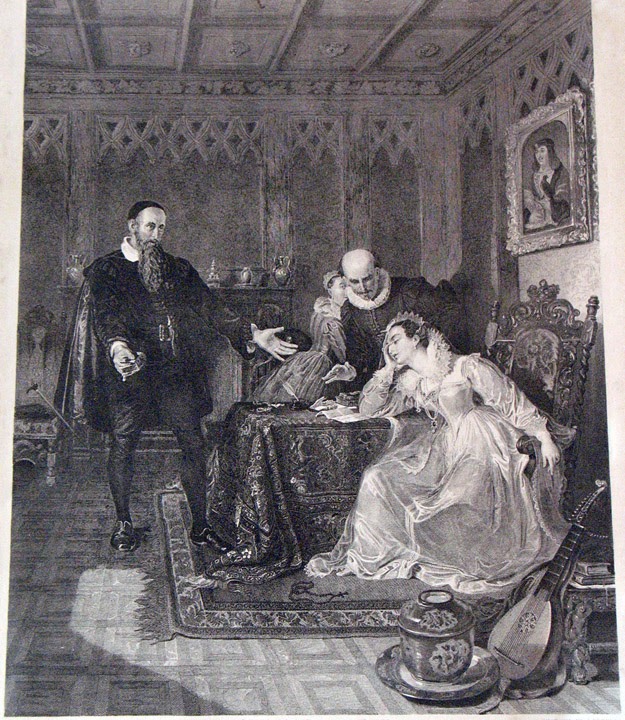
19th century engraving by John Burnet from painting by Sir William Allan, \
{{PD-Art}}

I did not embark upon my review of First Blast of the Trumpet expecting to have fun.  Being a fellow member of the community of historical novelists drawn to the life and times of Marie Stuart’s Scotland, I was no stranger to the author’s wit or her writing style, so I should have been forewarned. My first surprise was discovering  that MacPherson’s first book  in the Knox trilogy is not a novelized biography of the early life of John Knox. It is a feasible if fictional tale of the politics and persons who produced him, especially the Sixteenth Century persons  MacPherson cleverly nominated to serve as his parents. She takes full advantage of the fact that the details of the Reformer’s origin remain vague  and picks a pair of actual characters whose histories would have made them compatible. If  Knox was not their son, he  certainly could have been.

Thus, this  is not  a story about young  Knox,  although he is central to the theme. It is more the  tale of Elizabeth Hepburn,  a sixteenth century Scottish woman  who becomes  a female monastic by accident, not design, and who manages to survive a long list of mishaps with little  help from anyone but herself and a cluster of amazing  women who stand beside her. The plot emphasizes how little control most Reformation era women and many men had over their fates. Through the eyes of  MacPherson’s characters, we acquire insight into the  non-religious circumstances that brought so many men and even more women kicking and screaming into the monastic life. The same holds true of the political considerations that drove ambitious men  into the hierarchy of the Catholic Church.  


In First Blast, David Beaton is an excellent example and he  makes an outstanding and almost sympathetic villain. After all, he too is a victim of the times. While there are exceptions, generally, the men other than martyr  Wishart  do not come out looking quite as heroic as the women in MacPherson’s book.
Cardinal David Beaton from  17th century engraving by S. Freeman,
{{PD-Art}}


Many readers will be surprised to find very little about Knox in the first half of the book. Instead we are  treated to an excursion into pre-Reformation Scotland, getting an ample lesson in the need for clerical reform as we are introduced to the parade of mistresses and bastard children of the leading clerics of the day. This is pure, accurate and compelling Scottish historical fiction spiced with irony, wit and just enough comedy to make us wonder why we expected this to be a somber read. Even the minor characters  advance the story insofar as they reveal not just who Knox was, but in the artful way they demonstrate why Knox was.  One of my favorite scenes illustrates  the rivalry between the king’s favorite mistress Margaret Erskine and Cardinal Beaton’s mistress and mother of his many children Marion Ogilvy. It is much more fun to explore the ecclesiastical excesses of the Sixteenth  Century Catholic Church by looking into Mistress Marion’s mind and life situation than it would be to sit through one of Knox’s sermons on the topic. Also, the cultural color introduced in the pages is not limited to personalities. The rituals and celebrations of the Stewart court enliven the story with little resort to narrative. We see that not all of Sixteenth Century Scotland was somber. There were robust good times offered to those who knew where to look and how to earn a ticket.
The martyrdom of George Wishart, Knox's mentor {{PD-Art}}


 It is also surprising to find a book  with such an auspicious title with such a  generous  helping of romance. Trysts  are not limited to just those between the protagonist and her sometimes lover, who MacPherson writes in and out of the story artfully and with a bit more empathy that he perhaps deserves. Even Cardinal Beaton’s lovelife is explored with a tad more tolerance than his assassins thought to be his due.  MacPherson  presents the romantic entanglements of the protagonist in a light that makes the reader crave a romance novel’s satisfactory  ending while knowing that in the climate of Early  Reformation Scotland, it is unlikely to happen. Overall, it is surprising just how entertaining a well researched historical novel can be. Even though the story involves a historical person many of us see  as a stiff-necked disciplinarian with a propensity for serving up large portions of hell  and damnation in long-winded sermons,  it is hard to finish the last page without glimpsing a very human side to John Knox.

If there is a single  feature that some readers may find troublesome in the early  pages, it is the liberal use of Scottish slang and vernacular speech in especially in the early pages. For those unfamiliar with Scots, after the first two chapters, the Scots will no longer be distracting and will add authenticity and color to the reading adventure. One might even pick up a phrase or two from the character  Betsy.

It is settled fact that the historical Knox had the ability to fill a kirk to overflowing. This  fine book deserves the same large audience. It is brim full of love and hate, bravery and cowardice, hope and disillusionment  and  a large helping of  intrigue.  The visual imagery is superb, from the tender though sparse love scenes between the abbess and her lover to the account of  Knox’s mentor Wishart’s martyrdom or  the descriptive fate of Cardinal David Beaton’s pickled corpse. I take heart that this is part one of a trilogy. There is a Reformation on the horizon and I expect Marie MacPherson to  present it  with the integrity of a historian  and the lusty wit of a balladeer.  


A note:

You can find this book in the US and Kindle editions on Amazon.  I would provide a link but then, the Amazon police would accuse me of being a promoter instead of a voracious reader who knows an exception book when she finds it. I do know Marie MacPherson as a fellow member of the Marie Stuart Society with an educational background in the history of the Scottish Reformation. 

Wednesday, February 12, 2014

The Story of Marius the Giraffe by Linda Fetterly Root

Marius the Giraffe, R.I.P
When I was a child in Cleveland and a student at Euclid Park Elementary School, I won a book.  I am still winning books. But this week I am putting aside my most recent prize, The Red Priest's  Annina by Sarah Bruce Kelley for one that is haunting me more than anything any fiction author such as myself could ever write.  It is  a book I won in second grade--It was a contest sponsored by the Cleveland Public Library in connection with our on-site school library and our art program.  How the contest worked was each student entered a drawing in which they were given a book and assigned to do a drawing of its cover. I was lucky, because I was tasked to create an artwork from the children's version of Frank Buck's spellbinding book 'Bring'Em Back Alive, a book called Jungle Animals. On several occasions over recent years  I have searched the web for it and found it nowhere.Not only did it have a magnificent black jungle cat  on the cover but wonderful plates.  I specifically recall the composite of the various Birds of Paradise and the Mandrake with its colorful rear end, but most of all, I remembered drawings of the savanna animals in their habitats and of course, the glorious panther. I won the contest and the prize was a copy of the book.  My God, how I wish I had it in my hand. My Dad had my artwork framed and kept it until I went away to college.   But, My God, how I wish he'd kept it!  But it was not just the beauty of the book that I remember.  It was it's message: that animals should not be a hunter's prize. Buck had indeed been a great white hunter in the classic sense, but he later chose to trap instead of kill and deliver his prizes to zoos, where they would be preserved and hopefully thrive.

 And until two days ago, like Pollyanna, I believed that was the mission of a zoo.  But a little guy named Marius changed all that for me.  He was 17 months old and his favorite thing was rye bread. And they murdered him because he had the wrong genetics for their breeding program.  And who is the leader of this band of thugs? Not one of the grinning group of people who go to Africa to kill things from their Range Rovers --not the poachers who want an ivory tusk or an elephant foot for some sycophant's footstool.  Not at all. The zoo manager arranged it, announced it in advance, and justifies it still by calling it culling.  And he is really a nice guy at heart because he arranged for Marius to have a slice of rye bread before an employee shot a bolt into his brain.  Not because Marius was ill and suffering.  Not because he was violent or uncontrollable. But because he did not fit the genetic profile needed in the zoo's breeding program.

And the officials at the Copenhagen zoo excused dissecting him and feeding his body parts to lions while a large group of children watched because of the  educational value of demonstrating to the children what they explain is the natural fate of giraffes living in the wild.  But Marius was not living in the wild. He was never  given the opportunity to drink from that pond in the savanna pictured in Frank Buck's lovely book. And that upsets me.

His survival would not have been an economic burden to the zoo. Two other  zoos had offered to take him, genetics be damned.  A private donor offered hundred of thousands of dollars to save him.  So they killed him to prove a point. And thus, this is not about zoo management at all. Look at the facts.  If they did not want him at the Copenhagen Zoo, there were other places willing to take him.  So,in essence, this is all about power. They murdered Marius because they could.  I find it especially alarming today to read accounts of other zoo keepers defending the killing of Marius but not the manner in which it was accomplished. The defense is that culling of zoo animals is a good thing. What the group in Copenhagen committed was not a needless slaughter of a trusting animal who was their ward, but a colossal P.R. failure.  Have we become so callous that we can accept that?

And yes,I found the book on Ebay.  It was published in 1945, part of the same printing a the book I won.  And I bought it, another purchase of something without a use--like Marius.  But a thing of beauty none the less, and with a message, none the less.

Said Buck in the book's foreword:


 "I have traveled and lived in the jingle countries of the world for more than thirty years. My purpose in this sort of life was to bring back alive specimens of animals, birds and reptiles which inhabit these strange far-off lands so that American boys, girls and adults as well, might see and study them in our fine zoological gardens. In this book I have gathered together information that I have learned at firsthand about many interesting creatures of the jingle and veldt. It is my hope that you, in reading this book and looking at the pictures, will become better acquainted with these exotic species which, however strange to us here in America, are still a definite and breathing part of the world in which we live."

But only if we become proper custodians, Mister Buck!.

Wednesday, January 29, 2014

HAUNTED FYVIE CASTLE by Linda Root


Legends surrounding Fyvie castle did not begin with the discovery of bones buried within its walls during the early Twentieth  Century. The following lines were popularized during the Thirteenth Century by the well-known prophet laird of Earlston, Sir Thomas Learmonth, known in Scottish history as Thomas the Rhymer, or True Thomas.  According to the ballad  True Thomas enjoyed a prolonged stay at Fyvie during his travels, developing a close friendship with its lady. Some legends propound that it was during his visit there that he developed some sort of second sight in an epiphany that rivaled that of Saul on the road to Damascus.  And in addition to expounding prophesies,  he  collected folklore.  The best known from Fyvie is the Legend of the Weeping Stones.

Before Thomas's time, three stones  were taken from a sacred burial ground and used in the construction of the castle.  No matter where they were placed, they were always wet and a legend evolved that they would remain so until returned to whence they had been taken. And along with the legend came a curse:  until they were  returned to the burial mound, no laird of Fyvie would beget an  heir at Fyvie who would live to inherit the castle.  Whether one believes in prophesy or haunting, that part of the prophecy apparently rings true. Over the years, hardly any  son of an owner of  Fyvie castle who was born within its walls has lived to inherit it, and many of the lairds remained childless.  For example, not a single heir inherited during the recent Leith-Forbes tenure, and the famous Seventeenth Century Chancellor of Scotland Alexander Seton had to marry three wives before a healthy son was producted and Charles  was born at Dumfermline, not at Fyvie.  He had three sons, none of whom survived him and the title when to his brother, who died childless.  The property is now owned by the National Trust for Scotland, all private owners having given up the ghost, so to speak.
Fyvie, Fyvie, thou’s never thrive
As lang’s there’s in thee stanes (stones) three
There’s ane intill (one in) the oldest tower,
There’s ane intill the ladye’s bower,
There’s ane intill the water-yett (water gate)
And thir three stanes ye never get.

As to the stones, only two  of the three have been identified and only one has been recovered and is on display in the castle where it is placed in a bowl, and although it is sometimes dry,  at other times it is wet enough to fill the bowl with water.


Photo licensed and credited  © david sanger photography / Alamy


I first began my exploration of Fyvie Castle's hauntings when I was writing my debut novel, The First Marie and the Queen of Scots.  Those who have read the story know that the First Marie in my story is Lady Marie Flemying, the chief of the Four Maries, the four little girls  who accompanied the Queen of Scots to France in 1548 when they were  five or six.  Petite blonde Marie Flemying was rumored to be the only one of the group who dared call the queen to account when she was arrogant or cruel.  But in addition to her assertiveness, there was another reason why she ranked first among the Four Maries.  She was Marie Stuart's cousin. Her mother Janet Stewart, Lady Flemyng, was the bastard sister of James V, the little queen's father who died when she was six days old.  Lady FLemyng was Queen Marie Stuart's governess until she offended the French queen and the royal mistress by getting pregnant by the king.

Although Marie Flemyng was called the most beautiful blond woman in Europe by the scholar Bransom and the poet Ronsart during her thirteen years at the Court of Henri II,  there is no contemporary portrait of her or  any of the other Maries. Scenes depicting the queen and her ladies are for the most part Victorian in origin.  Historical novelists often describe her of having bright red hair, apparently relying on her nickname, La Flamina, which may have been shortened to Flamy by the queen when they were wee.  However, the moniker actually has nothing to do with her hair color, and refers to her family's origin, which traces back to Flanders. The first of the Flemyings had come to Britain with the Conquerer and Marie Flemyng's ancestors  had fought beside the Bruce at Bannockburn.
There is much inaccuracy in accounts of Marie Flemying's life after the Four Maries returned to Scotland with the widowed queen in 1561 and about her marriage to Sir William Maitland of Lethington, the most celebrated statesman of his day, whom Elizabeth called 'the flower of the wit of Scotland.' Contrary to reports on Wikipedia that the marriage was unhappy, Marie Flemyng, Lady Lethington, remained at her husband's side within Edinburgh Castle during the Lang Siege (1570-1573') and fought to keep his body intact after his enemy the Regent James Douglas, Earl of Morton, sought to have it posthumously tried and subjected to a traitor's grisly death. She plead her case to Cecil and Elizabeth and won, Elizabeth declaring that in England such punishments were reserved for the living, and that Maitland had died innocent before the law.  Many historians state  that Lady Lethington  never remarried after Maitland's death but that is not so. They just have not looked beyond the popular sources. Other sources mention that Maitland was her second husband, and that  George Meldrum who was a favored Scot at the court of Henry  VIII and present at the monarch's deathbed was her first husband. Any historian worth his salt can see the problem there, since Henry Tudor died in 1548  and his Scottish friend  died soon after. But using the name George Meldrum as a starting point, I began to search for a Meldrum-Flemyng connection that made sense, and with only  minor effort found that Marie Flemying, married George Meldrum, Lord Fyvie,  the laird of Fyvie Castle sometime after 1583, at least ten years after Maitland's death. Lord Fyvie was childless at the time of the marriage and remained so, and thus propagated the curse. He was also one of Scotland's most beleaguered  debtors.  On the surface it might appear as  if Marie Flemyng did  well for herself  by marrying an important baron, but such was not the case.  Records of the courts in Aberdeenshire indicate that she was often a party to lawsuits stemming from her husband's debts and spent considerable time in court until failing health excused her of further appearances.    One wonders if The Rhymer's curse was contagious, because during her short terms as Lady Fyvie, not only was Meldrum's  castle and his title sold to Alexander Seton , but Lethington Towers was lost to the Maitlands  when Marie Flemying's  brother in law John Maitland bought it from her son James 'on the cheap' and sold it outside of the family to pay a debt allegedly owed by young Maitland to his Seton cousin Alexander, who by then was the new Baron Fyvie.

 And that brings us to the story of the castle's most famous ghost, the Green Woman. who is believed to be a victim of Alexander Seton's ambition and greed.  She haunts the castle dressed in a diaphomous green gown, and leaves the scent of roses in her wake.  But is she Lilias Drummond?


Alexander Seton is an interesting character, one of the prominent Catholics who survived the Scottish Reformation in spite of his unwavering support of the Queen of Scots, and not just during the Douglas Wars, but as long as she lived.  Not only did he remain a prominent member of the government of James VI, but he became a Privy Counselor and the de facto guardian and tutor  of the king's second son, the slow developing Prince Charles, Duke of Albany, later ill-fated king Charles I. How much of  King Charles's  shortcomings may be laid at the feet of Alexander Seton is open to debate, but Seton obviously supported the king's Catholic leanings.  The Setons never were recusants. They were known Catholics throughout  the period when most of the Catholic aristocracy either fled to Europe or went underground. After the ascension of James VI to the English throne as James I, Seton continued in His Majesty'ms service and in 1605 was made Earl of Dumferline. He was very much a favorite of  the Danish consort, Queen Anne  who converted to Catholicism shortly after her husband James's ascension.  But if there was one disability that plagued Seton, it was that his wife Lilias Drummond had provided him with a chain of daughters, but not a single son. Like Henry VIII, his affection for Lilias  waned and he found himself another prospect.  And like Henry Tudor, the first wife made way for the second.  The controversy has to do with the means by which the switch took place.  Some stories have him sealing her into a small secret room and starving her to death,  but the more likely explanation is that he sent her off to one of his estates  in Fife and openly took up with the other  woman, Lady Grizel Leslie of Rothes.  In 1601, the formerly happy and healthy Lilas died quite suddenly and within six-months,   Seton married Grizel. But their  wedding night was less than blissful.  It seems there was a third party in attendance.  The newlyweds were kept awake by a cacophony of sounds coming from just outside the room. The next day the name D. Lilias Drummond was found etched on an outer sill at an inaccessible height. It is still faintly visible.


 From that time forward, there have been appearances of a female apparition called the Green Lady and there is  a recent recording of the sounds she makes on You-Tube and a photograph of a strange glow visible from the courtyard after dark. In keeping with the curse, Seton's second marriage yielded no son, but the third one was the charm. Although the second Earl of Dumferline was not born at Fyvie and was attainted for taking the losing side in the civil war, he did have two sons, neither of which left a male heir. Ownership of the Castle passed to the Gordons.  Adding to the  mystery, a painting that had apparently hung in the castle and which was said to be a portrait of Lilias Dummond, although not a contemporary one, has repeatedly gone missing only to reappear, and currently has disappeared again, without a trace as to its whereabouts.  Apparently a black and white photograph is all that remains.


There is another female apparition keeping the Green Woman company, a ghost known as the Grey Lady, and she is much more confrontational that the Green Woman. She is not as noisy as Lilias Drummond, but those who have seen her find her much more frightening. Some say she was the daughter of one of the early lairds and  was locked away to keep her from going forward with an unsuitable marriage. Others, including Helen Murphy Howell, whose post  Murder, Curses And Ghosts - Fyvie Castle in Scotland is more comprehensive than this one and is highly recommended, propounds the theory that the Grey Lady is the ghost of one of the  early Lady Meldrums, a contemporary of True Thomas, and that she had expressed a wish to be buried within the castle. Her spirit rested peacefully within a secret room until her bones were discovered and removed during the 1920's during a renovation by the Leith-Forbes owners.  The problem with the theory expounded by Ms. Howell is the fact that the Meldrums did not acquire the castle until much later.  There is no authoritative identification of the remains, but they are most certainly real. At the direction of the owners, the remains were removed and buried with dignity and care in a nearby cemetery, but the  Grey Lady was not happy, and it was then that the haunting began, and they were apparently disturbing enough to drive the workmen and servants to find employment elsewhere. The owners were sufficiently impressed with the credibility of the reported sightings that the bones were exhumed and reburied in the secret room where they originally had been discovered.  However, the cursing and the wailing of the Grey Lady did not stop and now the room has been sealed off.  In Michael Balfour's book  Mysterious Scotland: Enigmas, Secrets and Legends  he places the secret chamber  below the Charter Room where there is a sculpture of a turk's head apparently associated with Lord Byron,  and dating to  the period when the Gordon family held title to the castle.
 Below it there is a  sealed window that is generally believed to close off the secret room.  According to legend as  Balfour states it, if anyone dares to break into the room the intruder will perish and any surviving spouse will go blind.  At that point, the owners sold the property to the Trust.

There is yet another significant apparition associated with Fyvie Castle  dating to the Seventeenth Century,  and that one is male. He appears as a young man clad in tartans who stands outside of the castle walls in various locations on the grounds.  He is commonly linked to a tale of unrequited love in which a man named Andrew Lamb, who had been the laird of Fyvie's trumpeter plays a major role.  Unfortunate Andrew was sent into involuntary servitude because he had fallen in love with a miller's daughter, a comely lass named Annie, who was coveted by the laird, which in the eyes of the miller was a much more profitable match.  Thus, both the current Lord Fyvie and the miller sought to rid themselves of Andrew. By the time Andrew returned from the West Indies, his beloved Annie had died of a broken heart.  In retaliation, Andrew placed  a curse upon the castle and it's owners, declaring  that trumpets would sound to announce his presence whenever a laird of Fyvie lay dying. Over the years there have been numerous reports of the sound of a trumpet and the sighting of a young man dressed in tartans.  The tale has been propagated by the folk ballad The Trumpeteer of Fyvie, also know as the Ballad of Mil Tifty's Annie. The Annie in the folksong is alleged to be Agnes Smith, who died in January 1673 and is buried in the Kirkyard at Saint Peters in Fyvie. The statue atop the turret at Fyvie is believed to be that of Andrew blowing his horn at the mill.
Photo by Stanley Bruce (Bard of Buchan)


There is no explanation offered as to why a laird of Fyvie might have wanted to place a likeness of Andrew Lamb (Lamme) on the tower at Fyvie, except perhaps to appease the apparition and transfer blame to Annie's father.
To readers  interested in the haunting at Fyvie Castle, there is even a site where one can purchase items said to have magical powers and which  are fashioned from the heaps of  trinkets left as tributes to the ill fated lovers by visitors to the secret room where the Gray Woman's remains were reburied  before the laird had it sealed off.  There are several versions of the ballad  of the trumpeter available as CDs. There are many different versions of the story of the Green Lady, who generally is a rather benevolent ghost who appears as a well dressed beautiful woman dressed in fine clothes consistent with an  early Seventeenth Century aristocrat who leaves a scent of roses in her wake. She is a much less aggressive apparition than the one portrayed in my current work in progress, The Green Woman, who is the Guardian of  Ferniehirst Castle in Roxburgeshire on the Borders.  The first Countess of Roxburge was Marie Fleming's daughter Margaret Maitland.